NEWSROOM
Here we share with you various MCNEX stories.
- TitleMCNEX Radar Sensing Module the all-weather solution that perfects the DATE 2025-10-20
-
Advancing the future of autonomous driving with ultra-high-resolution 4D imaging and sensor fusion technology.
The transition to full autonomous driving (Level 4–5) hinges on achieving perception capabilities that surpass the human eye.
While cameras deliver rich visual information, their performance inevitably declines in harsh weather or low-light conditions. LiDAR enables precise 3D mapping, but it remains susceptible to weather interference and its high cost is still a barrier to mass adoption.Radar (Radio Detection and Ranging) technology is the key to overcoming these limitations—providing reliable perception data in any environment.
Leveraging over two decades of leadership in the mobile and automotive camera module market, MCNEX has combined its ultra-precise manufacturing expertise and advanced signal-processing know-how to introduce an innovative Radar sensing module designed to meet the stringent demands of next-generation autonomous driving systems.
This article offers technical insights into how the MCNEX Radar Sensing Module not only completes the “eyes” of autonomous vehicles but also transforms the in-vehicle experience.
1. The Era of Autonomous Driving: Evolution and Challenges of Sensor Technology
The perception capabilities of an autonomous driving system are realized through sensor fusion—the integration of data from multiple sensors.
Each sensor comes with its own strengths and limitations, and by complementing one another, they collectively enhance the robustness of the perception system.
Sensor Type Strengths Weaknesses Camera High resolution, excellent color/text recognition, low cost Vulnerable to adverse weather (rain, snow, fog), poor performance in low light or backlight Lidar High-precision 3D point cloud, high angular resolution Low penetration in adverse weather, high cost, mechanical complexity Radar Excellent all-weather performance, superior long-range and speed measurement Low resolution in conventional radar, difficulty in object classification Conventional automotive radars have primarily been used in functions such as Adaptive Cruise Control (ACC) and Blind Spot Detection (BSD) to determine an object’s presence, distance, and speed.
However, as autonomous driving levels advance, systems are now required to go beyond simple detection—to accurately interpret and predict the surrounding environment. This poses challenges that traditional radar technology alone has struggled to overcome.
It is precisely at this point that MCNEX’s technological innovation begins.
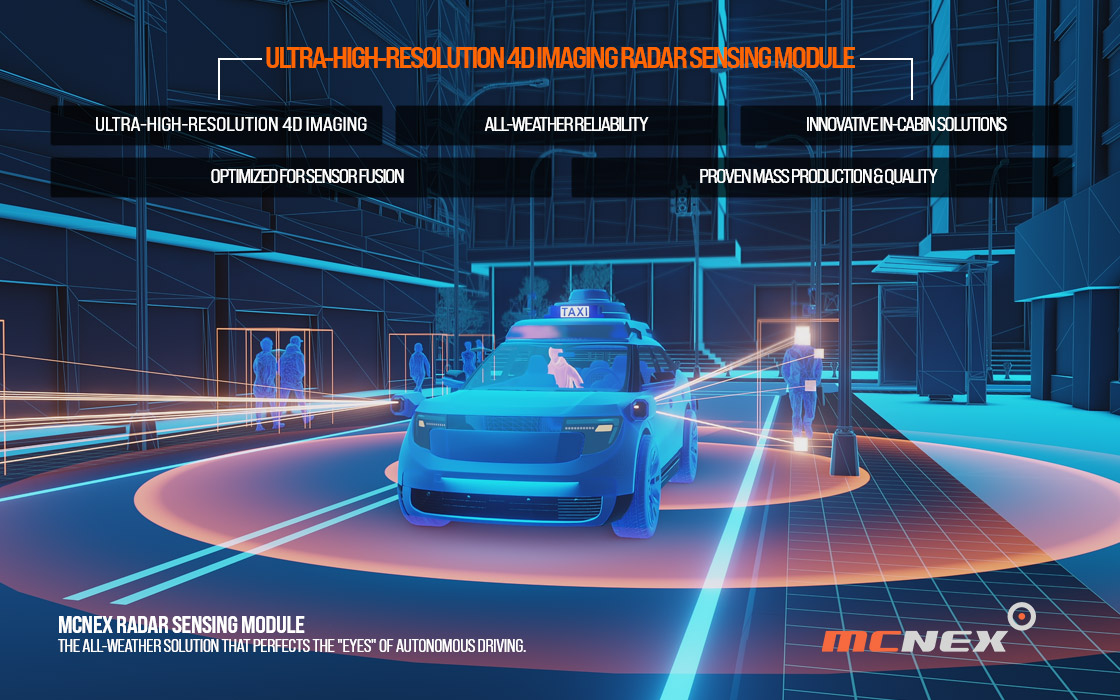
2. Ultra-High-Resolution 4D Imaging Radar Sensing Modul
To overcome the limitations of traditional radar, MCNEX has combined cutting-edge mmWave (millimeter-wave) technology with its proprietary antenna design and signal processing algorithms.
The result is a 4D imaging radar that adds elevation information to conventional range, velocity, and azimuth data enabling the system to render the surrounding environment as a high-density point cloud with exceptional detail.
Key Technical Advantages of the MCNEX Radar Sensing Module
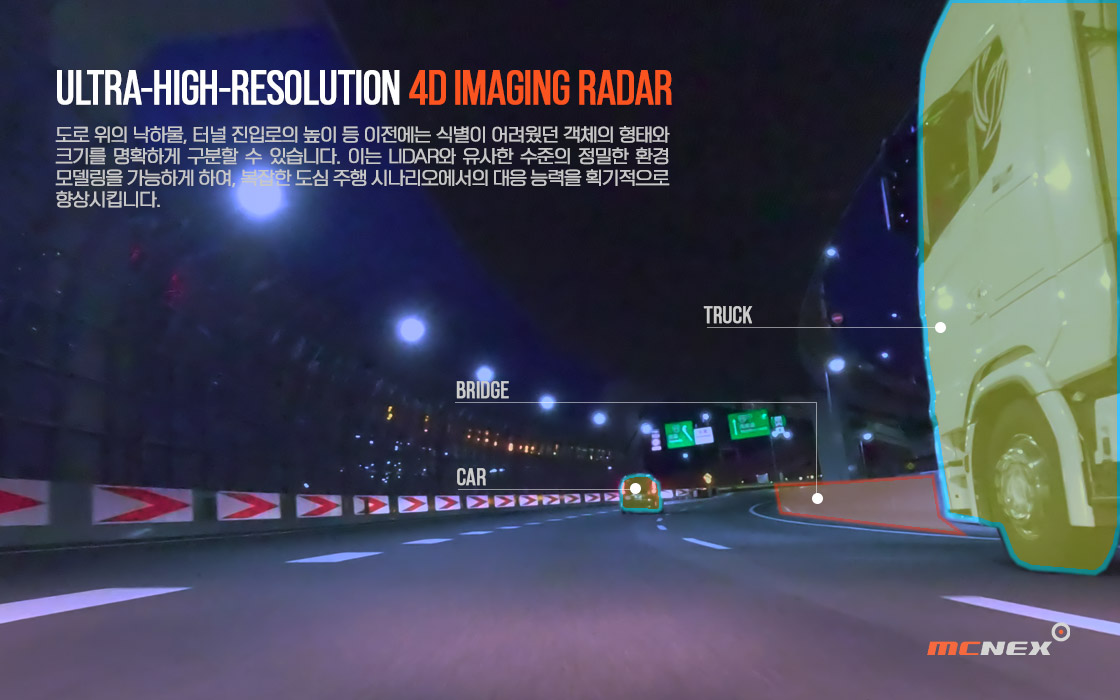
1) Ultra-High-Resolution 4D Imaging (Superior Resolution & Point Cloud Density)-By applying virtual antenna array technology and high-speed signal processing chipsets, MCNEX maximizes both horizontal and vertical angular resolution.
-This enables precise identification of objects that were previously difficult to detect such as stationary vehicles, pedestrians, road debris, or the height of a tunnel entrance. The result is LiDAR-like environmental modeling accuracy, dramatically enhancing performance in complex urban driving scenarios.
2) All-Weather Reliability
-Operating in the 77–81GHz mmWave band, the module offers excellent wave penetration through rain, snow, fog, and dust, ensuring stable object detection even when cameras and LiDARs struggle.
-MCNEX applies IP69K-rated housing and advanced thermal management to guarantee reliability under extreme temperature and humidity conditions.
3) Innovative In-Cabin Solution
-MCNEX’s high-resolution radar technology is optimized not only for external sensing but also for in-vehicle monitoring.
-Child Presence Detection (CPD): Detects even subtle breathing patterns to prevent infant and child abandonment accidents (compliant with Euro NCAP 2025 requirements).
-Occupant Detection & Classification: Identifies occupant position and physique (adult/child) to optimize airbag deployment and enhance seatbelt warning accuracy.
4) Optimized for Sensor Fusio
-As a global leader in camera module technology, MCNEX goes beyond supplying standalone sensors to mastering efficient radar-camera data fusion.
-The radar module supports synchronized data output protocols aligned with camera FOV and integrates with deep-learning-based fusion algorithms to maximize both classification accuracy and localization precision.
5) Proven Mass Production & Qualit
-Even the most innovative technology must be reliably mass-produced to create value. MCNEX leverages its SCM network, automated manufacturing lines, and rigorous quality control systems meeting or exceeding AEC-Q100/104 standards built from producing hundreds of millions of camera modules annually.
-This ensures automotive OEMs and Tier 1 suppliers receive both competitive pricing and trusted quality in every unit.
3. Shaping the Future of Autonomous Driving with MCNEX
MCNEX’s radar sensing technology demonstrates exceptional capabilities across 4D mmWave, road-surface-prediction-based chassis control, sensor fusion, AI/ML-based perception, and embedded deployment—delivering a balanced blend of safety, intelligence, cost efficiency, and product reliability.
Through continuous technological advancement and real-world validation, MCNEX is building a strong foundation to secure a leading position in autonomous driving and ADAS markets.
The MCNEX Radar Sensing Module is more than just a component it works alongside cameras and LiDAR to complete the perception system of autonomous vehicles, serving as an integrated safety solution that protects drivers and passengers both inside and outside the vehicle.
With globally proven precision manufacturing and quality control capabilities, MCNEX is fully prepared to meet the most demanding requirements of automotive engineering. We deliver tailor-made solutions to turn our customers’ vision into reality, moving forward in close technological partnership toward our shared goal a safer future for autonomous driving.Discover how MCNEX’s radar technology can empower your next-generation mobility projects.